Acknowledgements
Boris' Method
Before sase existed, Boris Cherny -- the inventor of Claude Code -- pioneered a practical workflow for parallel agentic development: five git checkouts, each in its own tmux tab, each running Claude Code in plan mode. This was one of the first demonstrations that a single developer could effectively supervise multiple agents working on different tasks simultaneously, and it proved that the bottleneck in agentic software engineering isn't the agent -- it's the coordination layer around it.
sase builds directly on this insight. Where Boris' method relies on the developer to manually manage the parallelism -- switching between tmux tabs, keeping track of which checkout is doing what, copy-pasting prompts, and mentally tracking the state of five concurrent workstreams -- sase replaces that manual overhead with structured infrastructure:
- Workspaces instead of manual checkouts -- sase's workspace provider system creates and manages isolated working copies programmatically, eliminating the need to manually set up and maintain parallel git checkouts.
- Patches instead of mental bookkeeping -- Each unit of work gets a tracked lifecycle with status, metadata, and history, replacing the cognitive load of remembering what's happening in each tmux tab.
- Macros instead of ad-hoc prompts -- Reusable, composable prompt templates with YAML front matter replace the prompt fragments scattered across shell history and scratch files.
- True SDD instead of plan mode -- Plan mode produces ephemeral plans that vanish
when the session ends. sase persists committed prompts in the agents sidecar, ordinary
tales and executable epics in the plans store, and exploratory notes in the
sdd/research/corpus. For larger efforts, epic files carry a bead ID in their frontmatter that links them to an epic-tier bead, and each phase of the epic gets its own bead whose ID appears in the corresponding commit messages -- creating a traceable chain from epic to phase to commit. For smaller tales, commit messages include aSASE_PLAN=<path>tag pointing back to the plan file. The result is spec-driven development where the full history of intent, decomposition, and execution is preserved and queryable, not trapped in a single agent's context window. - sase's TUI instead of tmux -- A single TUI provides unified navigation, filtering, and management across all active workstreams, replacing the manual tab-switching workflow.
- AXE instead of manual supervision -- A background daemon handles scheduling, monitoring, and lifecycle management of agent runs, so the developer doesn't need to babysit each session.
The core idea -- that one developer can multiply their output by running several agents in parallel -- was right. sase just replaces the duct tape with a proper framework.
Beads
Steve Yegge's
beads (bd) introduced a critical insight: AI
coding agents suffer from a "50 First Dates" problem -- every new session starts from
scratch with no memory of prior work. His solution was a dependency-aware graph issue
tracker designed specifically for agents, backed by
Dolt (a version-controlled SQL database), with
hash-based IDs for collision-free multi-agent writes, hierarchical epics-to-subtasks via
dotted IDs, atomic --claim operations for agent coordination, and semantic memory
compaction to keep the working set small. The key idea was that agents don't need TODO
files or markdown plans -- they need a structured, persistent memory layer they can
query and update across sessions, so that multi-session and multi-agent workflows stay
coherent.
The sase bead command is a from-scratch reimplementation that carries this idea into
sase's architecture while drastically simplifying the surface area:
- Rust-backed events plus compatibility mirrors instead of Dolt -- sase stores
canonical append-only events under
events/**, generates sortedissues.jsonlfor older tooling, and usesbeads.dbonly as the gitignored mutation flock. Fresh clones read the tracked events directly and can rebuild both mirrors without an external database engine. - Plan tiers, executable phases, and standalone tasks -- plan-like beads carry
explicit
planorepictiers, executable phases use hierarchical child IDs, delegated child epics can nest beneath phase/land work, and flat task beads capture independent follow-ups. Linked epics use--type plan(<plan_file>) --tier epic; epic approval creates the bead DAG deterministically andsase bead worklaunches one agent per phase plus a final land agent. The same command launches exactly one worker for a standalone task bead. - Checkout-local stores with normal VCS synchronization --
sase beadreads and mutates the active checkout's canonical store rather than merging numbered sibling workspaces. In-tree bead state moves between checkouts through the normal VCS path; local and sidecar policies resolve their own documented store roots. - No external binary -- beads ships as a ~37MB Go binary with its own daemon
process;
sase beadis installed as part of sase and uses the requiredsase_core_rsextension for local storage/query/mutation speed, with no separate daemon to run.
The philosophical debt is real: beads proved that giving agents structured issue
tracking -- not just chat history -- fundamentally changes what's possible in
multi-session agentic workflows. sase bead takes the ~5% of that system that matters
for sase's orchestration model and integrates it natively.
Research Papers
This project was heavily influenced by two research papers:
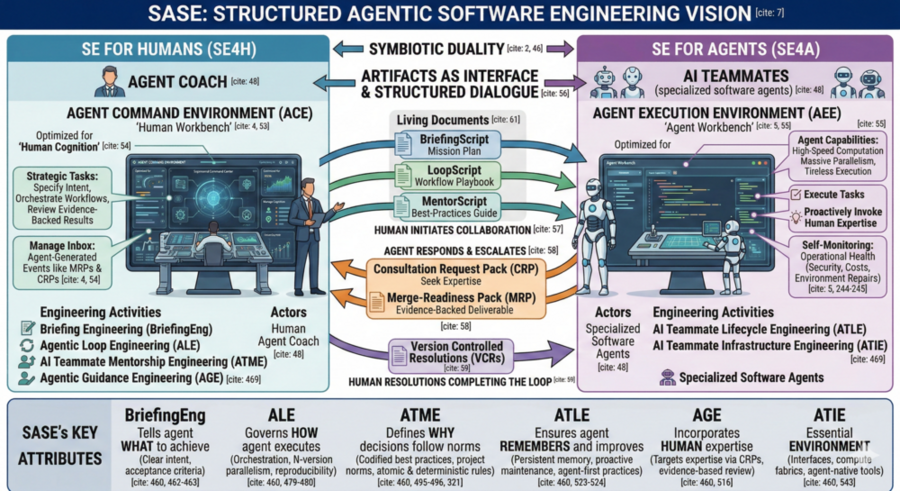
- Agentic Software Engineering: Foundational Pillars and a Research Roadmap
(Hassan et al., 2025) -- This paper's vision of Structured Agentic Software
Engineering (SASE) inspired the project's name and overall direction. Its concepts of
the Agent Command Environment (sase's TUI) and Agent Execution Environment (AEE)
directly informed the naming and design of the
aceTUI andaxedaemon, respectively.
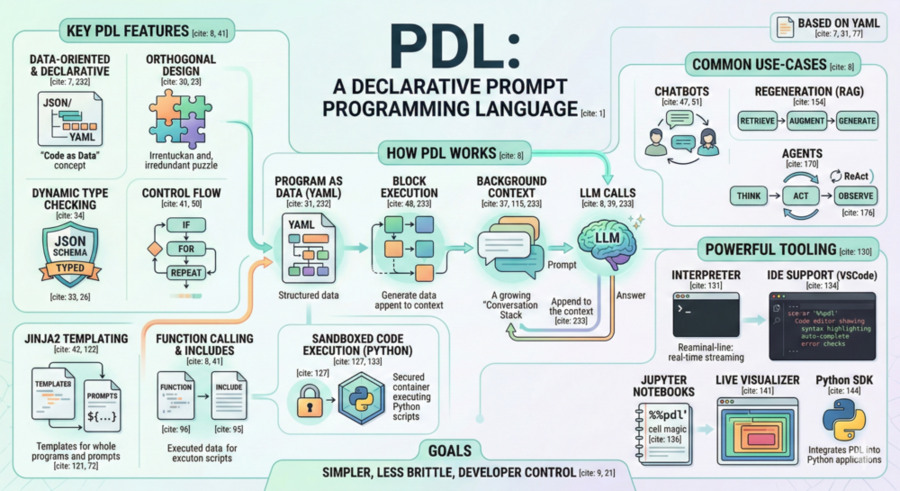
- PDL: A Declarative Prompt Programming Language (Vaziri et al., 2024) -- PDL's approach to declarative, YAML-based prompt programming influenced the design of macro workflows, sase's YAML-defined multi-step pipelines for orchestrating LLM calls and tool execution.
Images generated with Nano Banana (Google's NotebookLM) via Gemini.