Rust Backend (sase_core_rs)¶
A subset of sase's core APIs is served by a Rust extension distributed as
sase-core-rs on PyPI and built from the
sibling sase-core repo. sase declares
sase-core-rs as a hard runtime dependency (see pyproject.toml for the pinned range),
so a normal uv tool install sase (or pip install sase) pulls a prebuilt wheel
automatically — no Rust toolchain required and no env-var backend selection. Most ported
operations fail fast when the extension or a required binding is unavailable. The
agent-cleanup planner and cleanup-mutation wrappers are a temporary compatibility
exception: they retain Python fallback paths for missing or stale cleanup bindings.
The shipped Rust-backed operations are grouped by the Python facade that calls them:
- Project parsing:
parse_project_bytes - Project lifecycle helpers: normalize legacy state to canonical
enabled/disabled, read and updatePROJECT_STATE, derive the true-project predicate andgit/ghVCS kind, and list lifecycle-filtered project records for CLI/TUI/launch discovery. Internalsiblingbacking records remain parseable but are not true projects. - Query parsing and evaluation:
tokenize_query,parse_query,canonicalize_query, legacy one-shotevaluate_query_many, and the product persistent-corpus path (compile_corpus,compile_query,evaluate_many) used bysase.core.query_corpus_facade - Agent artifact scan/index and statistics operations:
scan_agent_artifacts,rebuild_agent_artifact_index,upsert_agent_artifact_index_row,delete_agent_artifact_index_row,query_agent_artifact_index, and dismissed projection replacement for hiding dismissed identities in indexed visible-inbox queries. Scan records project each run's launch-boundarymacros.json, the index signs that marker so late writes refresh the row, and the run statistics query rolls the projection up by macro, model, project, co-usage, and optional focused detail. - Status and status-transition helpers:
read_status_from_lines,apply_status_update, andplan_status_transition - Git query parsers:
parse_git_name_status_z,parse_git_branch_name,derive_git_workspace_name,parse_git_conflicted_files,parse_git_local_changes, VCS-log parsing, and standalone commit-origin classification throughclassify_commit_origin - Notification JSONL store operations:
read_notifications_snapshot,append_notification,apply_notification_state_update, andrewrite_notifications. The agent-keyed completion dismissal (DismissAgentCompletionsMatchingAgents) also covers row-owned settlement rows (epic-launch/monitor-settlement) that name an exact(cl_name, raw_suffix). The store owns every temporal snooze semantic: deadlines are validated as timezone-aware future instants and normalized to canonical UTC before any row changes (a rejected bulk snooze stays atomic), the current-state read expires due and malformed-legacy rows under the same exclusive lock it reads with, and snapshots/outcomes reportexpired_idsplus the earliest remainingnext_snooze_deadline. Expiry stamps one sharedresurfaced_atper batch, marks rows unmuted and unread, skips dismissed rows, and leaves permanent mutes untouched. Callers must not reimplement expiry, ordering, or deadline arithmetic in Python — seedocs/notifications.md - Temporary LLM provider-disable state:
provider_disable_wire_schema_version,provider_disable_get,provider_disable_set_relative,provider_disable_set_until,provider_disable_try_set_relative,provider_disable_try_set_until, andprovider_disable_clear. The Rust core owns the versionedllm_provider_disables.jsonschema, bounded lock, atomic writes, per-provider validation/pruning, expiry semantics, deterministic provider ordering, and multi-process read/modify/write cycle. Conditional try-set operations prune and decide absence-plus-write under that same lock, returning the active record plus whether the caller inserted it. Unconditional setters remain the replacement path for manual duration changes. Python owns provider registration, routing policy, TUI presentation, and the lock-free display peek overlay. - Shared macro choice assistance (contracts phase):
macro_argument_choice_candidatesandmacro_input_type_labelfrom the editor-completion domain. The candidate builder takes{"hint", "partial", "replacement", "selected"}wherepartialfilters (empty keeps declared order, otherwise case-insensitive prefix first then the shared Rust fuzzy matcher with stable declared-order ties),replacementis the whole current value for repeatable active-element detection, andselectedexcludes only repeatable values while keeping the edited element eligible. It inserts the exact canonical value (never the label), quoting structural macro syntax (commas,+), synthesizingtrue/falsefor bool, and marking the displayed default without reordering. The label is the value union for up to four choices, else<named_type> (N)orenum (N); domains show named types, scalars show keywords. Wires carry additivenamed_type/value_rolewith richvalue/label/descriptionchoices; old payloads without them still deserialize. - Agent cleanup planning plus deterministic cleanup mutations: dismissed-identity index writes, artifact-marker deletion, workspace-release text mutation, and hook/mentor/comment kill marking. These calls prefer Rust but retain cleanup-specific Python compatibility paths for missing or stale bindings. In the current sase's TUI host path, dismissed-bundle JSON persistence and its summary SQLite index are Python-owned.
- Agent launch preparation, low-level detached spawn, timestamp allocation, fan-out
planning, typed Agent/Proc launch-plan validation, admission-journal replay,
%ifcondition evaluation,%procscript/argv/env preparation, and RUNNING-field workspace-claim planning/mutation helpers - Bead data operations: read queries (
show,list,ready,blocked,stats,doctor, epic-child lookups), merged multi-workspace reads, mutations (init,create,update,open,close,rm,dep add, ready-to-work flags, sync-clean checks, compatibility projection export), deterministic epic work planning, and the earlysase beadCLI fast path for common read/write commands - Disk and retention owners: managed-temp reaping (
reap_managed_tmpdir), disk-pressure and disk-inventory classification (classify_disk_pressure,classify_disk_inventory), cleanup-outcome normalization, proc runtime retention (apply_proc_runtime_retention), andace-runretention preview plus its fail-closed apply refusal (apply_agent_artifact_run_retention). Each has its own wire schema version that the Python adapter checks before calling; the adapters gather inputs (filesystem measurements, protection facts, configured thresholds) and handle host-side follow-ups such as dropping reaped directories from the agent artifact index - Memory history over git alone (
memory_history_sync,memory_history_subjects,memory_history_resolve,memory_history_timeline,memory_history_version,memory_history_compare,memory_history_feed, andmemory_history_wire_schema_version), called throughsase.core.memory_history_facadewith scopes assembled bysase.memory.history.scopes. The Rust core owns lineage, shim aliasing, classification, cause attribution, the per-scope snapshot, and prose comparison; Python owns scope inputs, the thread-safe service, the CLI, the visual vocabulary, and all rendering. - Instruction manifest v1 (
instruction_manifest_wire_schema_version,normalize_instruction_manifest), called throughsase.core.instruction_manifest. The Rust core owns the closed vocabulary, the wire types, the validation invariants, and thecommon_digestdefinition; Python owns bundle composition and manifest assembly. - Git object-sharing planning for managed workspaces (
plan_git_object_sharing) - AXE configuration composition and entry-edit planning (
axe_config_compose,axe_config_plan_entry), including routine/job input aliases, description-shape diagnostics, and the public routine/job projection; the public routine/job status--jsonprojection (project_axe_status_public); and agent-tribe identity resolution, including the publicjobalias for the storedchoptribe (resolve_agent_tribe_identity)
The intentionally Python-owned host surfaces include:
parse_project_file— Python file-path API. The Rust binding consumes bytes; routing the file-path API through it would either re-read the file or duplicate the Python parser's tokenization for no measurable win.build_query_context,evaluate_query,evaluate_query_with_context— per-row query host logic. Batch product filtering uses a cached Rust query corpus; the publicevaluate_query_many(query, changespecs)API remains as a compatibility wrapper that compiles a temporary Rust corpus for one call.build_changespec_graph_index— Patch graph index construction.transition_changespec_status— the side-effecting status transition (acquires a file lock, rewrites the project file, performs archive moves and suffix renames). The pure decision step inside it routes through Rust viaplan_status_transition.- Project lifecycle mutations stay on the Python host path:
sase projectresolves the mutable ProjectSpec file, holds the ProjectSpec lock, checks liveRUNNINGclaims and artifact markers, and delegates only the purePROJECT_STATEparse/update/list operations to Rust. - Cross-project repo and workspace inventories are frontend-neutral Python adapters, not
TUI implementations.
repo_inventory.pycomposes Rust project records with Python-owned linked-repo config and SDD store records;workspace_provider/inventory.pycomposes them with Python workspace registries andRUNNINGclaims. The CLI and Admin Center consume these same adapters so their rows cannot drift. They are intended to move behind a Rust wire API when those inputs become core-owned. - High-level subprocess orchestration, process liveness checks outside launch, filesystem mutation outside the prepared prompt/output path, TUI rendering, and plugin entry points stay on the host by design.
- Agent launch host responsibilities stay in Python: provider/workspace plugin calls, VCS preallocation env mapping, project-file locking, workspace-directory cleanup, TUI notifications, macro catalog expansion, history writes, job registry recording, and user-facing launch callbacks. Rust owns deterministic launch planning/preparation and the low-level detached spawn binding.
- LLM provider registration, selector policy, temporary alias-override precedence, dispatch decisions, and sase's TUI Launch Control provider-routing UI stay on the Python host path. The provider-disable facade delegates durable state and mutation atomicity to the Rust binding, but Python remains responsible for deciding how an active disable affects aliases, completions, explicit requests, and already-running provider processes.
- Agent cleanup process signalling, dismissed-bundle persistence, dismissed-bundle
summary indexing, and TUI orchestration stay on the Python host path. The Rust
boundary owns reusable cleanup planning, compact dismissed-identity writes, artifact
deletion, workspace-release content rewrites, and Patch-entry kill marking exposed
through Python helpers in
sase.core.agent_cleanup_*. - Managed-workspace Git subprocesses, project locks, and filesystem mutations stay in Python. Rust owns the deterministic Git object-sharing policy: alternate path resolution, SASE-owned versus foreign alternate classification, and rewrite plans that preserve non-SASE entries.
- Bead host responsibilities stay in Python where they touch the surrounding
application: storage-location discovery, SASE workspace/project lookup, VCS prompt
context for
sase bead work, macro resolution, user confirmation, agent launch, rollback of already-spawned children, and telemetry increments. Rust owns the bead data model, storage/query engine, JSONL codecs, mutation transactions, single-store ID allocation, deterministic work-plan DAG, and CLI output planning. - Explicit and automatically captured artifact-file storage remains Python-owned because
it copies or moves files into
~/.sase/artifacts/and updates the local JSONL association index under a file lock. Reads and filtering of that artifact-file index go through the Rust-backedartifact_file_query_facade. Separately, Rust owns the agent-run artifact scanner and its persistent agent index. Python owns best-effort lifecycle orchestration around the agent index: syncing dismissed-agent projection inputs before sase's TUI loads, refreshing rows after marker mutations, and dispatchingsase agent index gc.
Why a Rust Backend?¶
The sase.core package is a stable Python facade carved out specifically so individual
operations can be re-served by faster Rust implementations one at a time. Parsing
project .sase files dominates many cold-path workloads (TUI startup, large search
results, axe routine scans), so it was the first operation routed through this seam.
Architecture¶
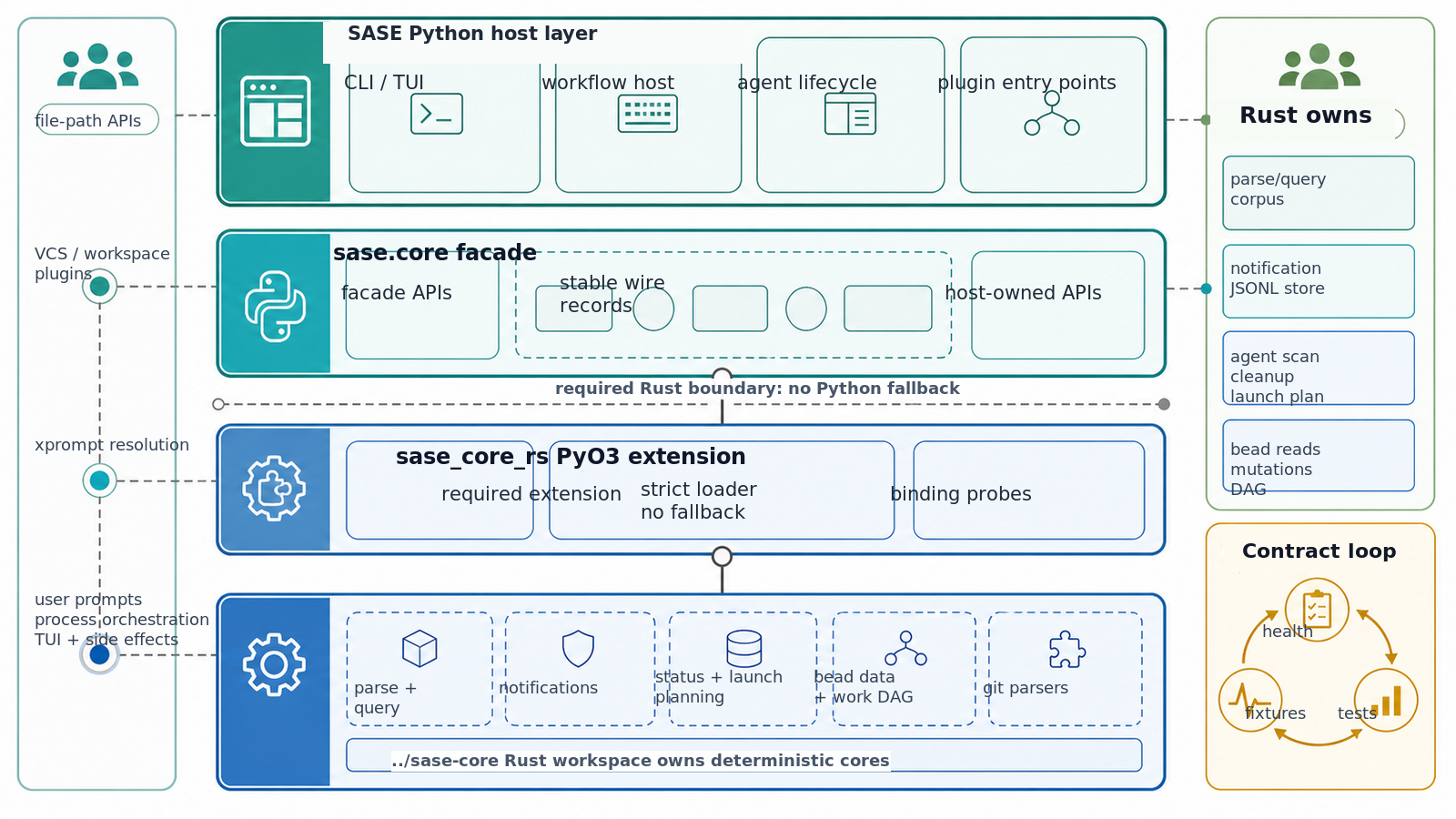
                ┌─────────────────────────────────────────────┐
                │              sase Python code               │
                └────────────────────┬────────────────────────┘
                                     │ calls
                                     ▼
                ┌─────────────────────────────────────────────┐
                │          sase.core (Python facade)          │
                │  parser_facade · query_facade · status_*    │
                │  agent_scan_facade · git_query_facade       │
                └────────────┬───────────────────┬────────────┘
                             │                   │
                ported facades                unported facades
                             │                   │
                             ▼                   ▼
                ┌──────────────────────┐   ┌──────────────────┐
                │  sase_core_rs (PyO3) │   │  Python impl     │
                │  required extension  │   │  (host logic)    │
                └──────────────────────┘   └──────────────────┘
Important boundary modules under src/sase/core/ include the following. This is a
guided map, not an exhaustive directory listing; some *_facade.py modules are
Rust-backed boundaries, while others are Python-owned host adapters.
| Module | Purpose |
|---|---|
rust.py |
Strict sase_core_rs loader (require_rust_extension, require_rust_binding) |
health.py |
sase core health Rust-extension probe + report |
parser_facade.py |
parse_project_file Python API + Rust-backed parse_project_bytes |
project_lifecycle_facade.py |
Rust-backed ProjectSpec lifecycle parse/update/list helpers |
project_lifecycle_wire.py |
Project lifecycle and project-record wire dataclasses |
wire.py |
Stable wire record types that cross the Python ↔ Rust boundary |
wire_conversion.py |
Python Patch ↔ wire record serialization |
query_facade.py |
parse_query (Rust); per-row query context/eval (Python host logic); batch compatibility wrapper over Rust corpus |
query_corpus_facade.py |
Persistent Rust query corpus wrapper for cached batch evaluation |
notification_store_facade.py |
Notification JSONL snapshot, append, rewrite, and state mutation facade (Rust) |
notification_store_wire.py |
Stable notification snapshot/update wire records across the Rust boundary |
status_facade.py |
Status line helpers + planner (Rust); side-effecting transition (Python host logic) |
graph_index_facade.py |
build_changespec_graph_index() facade (Python host logic) |
agent_scan_facade.py |
Agent artifact scan plus persistent index query/rebuild/update/delete facade (Rust) |
agent_scan_wire.py |
Stable wire records for agent-artifact scans and index maintenance |
agent_identity_facade.py |
Rust-backed agent identity, ownership, validation, and name-rewriting boundary |
agent_runtime_facade.py |
Rust-backed clan/session wall-clock runtime aggregation |
artifact_file_facade.py |
Compatibility import surface; artifact-file storage/default synthesis is Python-owned |
artifact_file_query_facade.py |
Rust-backed query facade for the persistent artifact-file index |
agent_cleanup_wire.py |
Stable cleanup planning and side-effect intent wires |
agent_cleanup_facade.py |
Agent cleanup target conversion and plan_agent_cleanup() facade |
agent_cleanup_execution.py |
Host-safe wrappers for Rust-backed deterministic cleanup mutations |
agent_launch_wire.py |
Stable launch, workspace-claim, and fan-out wire records |
agent_launch_facade.py |
Rust-backed launch preparation, spawn, timestamp allocation, and fan-out planning |
agent_launch_claims.py |
Rust-backed RUNNING-field claim planning/mutation helpers |
bead_read_facade.py |
Rust-backed bead read facade for one active bead store |
bead_mutation_facade.py |
Rust-backed bead mutation facade |
bead_wire.py |
Stable bead issue/dependency conversion helpers across the Rust boundary |
status_wire.py |
Stable wire records for the status state machine |
status_wire_conversion.py |
Python plan reference + project-file → request-wire converter |
git_query_facade.py |
Pure Git query parsers facade (Rust) |
git_query_wire.py |
Stable wire records for the Git query parsers |
git_object_sharing.py |
Rust-backed managed-workspace Git alternates planning |
managed_tmp_reaper.py |
Schema-checked adapter over the Rust managed-temp reaper |
disk_pressure.py |
Filesystem observation plus the Rust disk-pressure classifier |
agent_artifact_run_retention.py |
ace-run retention protection gathering plus the Rust preview/refusal owner |
agent_tribe.py |
Rust-backed tribe validation and public/stored tribe identity resolution |
instruction_manifest.py |
Thin adapter over the Rust instruction-manifest wire version and normalizer |
Command Line grammar handle¶
The : Command Line panel completes through the frozen CommandLineGrammar pyclass in
sase_core_rs (crates/sase_core/src/command_line/ in sase-core, bound in
crates/sase_core_py/src/command_line/). It is built once from the cached
sase completion spec -d -j file (src/sase/completion/command_line_spec.py) off the
event loop, then answers per keystroke: resolve (tokens, cursor slot, advisory
diagnostics, live signature, run policy), complete (fuzzy-ranked candidates), and
command_help (the doc peek). The sase side
(src/sase/completion/command_line_grammar.py) is only a loader plus typed views. Every
start, end, cursor, replace_start, replace_end, and match_runs value is a
Unicode scalar (char) offset, exactly a Python str index. The
COMMAND_LINE_GRAMMAR_SCHEMA_VERSION mirror (Rust COMMAND_LINE_WIRE_SCHEMA_VERSION)
fails fast on drift, and sase-core owns the fixture regeneration step
(crates/sase_core/tests/fixtures/command_line/).
Prompt prediction handles¶
Next-word prompt prediction compiles through the frozen PromptPredictionCorpus and
PromptPredictionModel pyclasses in sase_core_rs
(crates/sase_core/src/prompt_prediction/ in sase-core, bound in
crates/sase_core_py/src/prompt_prediction/). Each corpus compiles typed prompt rows
once off the event loop with the GIL released (recency-weighted n-gram mass, distinct
support, per-project partitions); a model cheaply composes frozen corpora (history,
session, archive) plus config and answers per keystroke: predict (confidence gate,
ghost continuation, menu candidates) and rank_prefix (context-aware current-word
ranking). Python rebuilds the model, not the corpora, whenever any corpus swaps. The
sase side (src/sase/core/prompt_prediction_facade.py plus the
prompt_prediction_wire.py dataclasses) is only a loader plus typed views, and
tools/validate_sase_core_rs probes the compile/predict/rank round trip. The
PROMPT_PREDICTION_WIRE_SCHEMA_VERSION mirror (Rust
PROMPT_PREDICTION_WIRE_SCHEMA_VERSION) fails fast on drift.
Prequential replay calibration¶
tools/prompt_prediction_replay scores the Rust prequential replay evaluator
(evaluate_prompt_prediction_replay) over typed prompt history and prints
aggregate-only tables (never prompt text). Method: typed rows are deduped, sorted oldest
first, warmed on the oldest 40%, then every word-boundary position of each later row is
scored before that row joins the corpus; per-position evidence is recorded once and the
threshold grid (min_p 0.40-0.85, min_margin 0.05-0.40, min_support 1-5) sweeps
over those records without replaying. Rows land in novel/mid/near-duplicate cohorts by
5-gram overlap with prior text (<30% / in between / >=70%). Each sweep point also
carries the novel-cohort coverage and precision so presets can be calibrated against
novel prompts without replaying.
2026-09-30 replay over 11,631 rows (3,301 typed after the generated-origin filter; 1,320 warmed, 1,971 scored, 142,120 positions; ungated top-1 43.2%, top-3 54.0%), run under the corrected support semantics (distinct support counts each observation once across history, session, archive and draft; the project partition only boosts mass):
| preset | coverage | precision | novel precision | mid precision | near-dup precision |
|---|---|---|---|---|---|
| cautious | 18.1% | 85.0% | 77.6% | 90.2% | 94.7% |
| balanced | 25.9% | 80.7% | 65.1% | 85.8% | 96.9% |
| eager | 59.0% | 62.9% | 40.6% | 68.3% | 93.5% |
Method: the sweep grid (min_p 0.40-0.85, min_margin 0.05-0.40, min_support 1-5)
scores 400 points over the recorded per-position evidence without replaying. Balanced
(min_p=0.75, min_margin=0.20, min_support=2) is the max-coverage point meeting overall
precision of at least 75% and novel precision of at least 65%; the margin is flat across
0.05-0.40 there, so it keeps its previous value. Eager (0.40/0.05/1) is the
max-coverage point meeting overall precision of at least 60%. Cautious (0.60/0.40/5)
is the max-coverage point meeting overall precision of at least 85% with novel precision
at least 5 points above balanced (77.6% vs a 70.1% bar); it is strictly tighter than
balanced via min_support 5 > 2, and the 0.40 margin is load-bearing at min_p 0.60 —
unlike the old 0.75/0.35/4, which gated exactly the same positions as balanced because
a 0.75 top-1 share leaves the runner-up at most 0.25. Coverage 18.1% vs 25.9% confirms
the two presets now gate measurably different sets. Calibration outcome: headroom is
thin everywhere that matters (balanced novel +0.1pp over its 65% bar, cautious overall
+0.0pp over 85%, eager overall +2.9pp over 60%), so re-run the tool before loosening any
preset.
Current-word completion¶
Setting request complete_current_word with the cursor inside a partial word runs the
prefix-restricted path (predict_completion in model.rs) instead of the boundary
gate. split_partial_word (tokenize.rs) splits the trailing token off the cursor text
— leading affixes ((, quotes, *, _, backtick, [) stripped, prefix kept exactly
as typed — and returns None for text ending in whitespace or boundary punctuation, or
a trailing token that cannot be a word (structural, hash-like, secret-like, over 32
characters): those fall through to the ordinary boundary path, so results stay identical
with the flag off. Candidates are restricted to vocabulary keys starting with the
casefolded prefix (’ folds to '), scored and gated over that restricted distribution
with a conservative denominator (score_and_gate_restricted); the menu still ranks the
restricted words, but a prefix shorter than the preset min_prefix_chars forces the
gate to None (non-confident, no completion). The draft counts only the text before the
prefix, so the partial word is never observed as its own successor. The completed word
keeps the typed casing and the suffix comes from the corpus surface (completion_word):
an all-caps prefix of 2+ letters uppercases the suffix, and a surface whose casefold
does not extend the typed casefold yields no completion. The ghost drops the completed
word itself and keeps at most max_words - 1 following words.
Python wire: request complete_current_word (default False) round-trips through
PromptPredictionRequest.to_dict; the result carries the frozen
PromptPredictionWordCompletion record (prefix as typed, word, suffix to insert —
empty when the typed word is already the predicted word), parsed with
.get("word_completion") so an older core without the field yields None.
Calibration (tools/prompt_prediction_replay --midword; report-time cutoff: rows with k
below a preset's min_prefix_chars report coverage 0.0 / precision null by design,
verified in replay.rs midword_metrics_for — they are not gate measurements). Full
replay 2026-10-01 (11,643 rows; 1,978 scored; 142,733 positions). Rule (plan
202609/next_word_autosuggest.md §8.2): smallest k with overall precision at or above
the preset target (cautious 85%, balanced 75%, eager 60%) and novel precision within 10
points of overall:
| preset | k | coverage | precision | savings | novel precision | mid precision | near-dup precision |
|---|---|---|---|---|---|---|---|
| cautious | 3 | 40.2% | 94.4% | 13.2% | 91.5% | 96.0% | 98.7% |
| cautious | 4 | 34.6% | 94.9% | 7.9% | 92.1% | 96.3% | 99.0% |
| balanced | 2 | 47.8% | 91.7% | 28.0% | 86.5% | 93.8% | 98.7% |
| balanced | 3 | 49.8% | 94.6% | 20.3% | 91.1% | 96.0% | 99.2% |
| balanced | 4 | 45.2% | 95.1% | 12.7% | 91.6% | 96.2% | 99.3% |
| eager | 1 | 72.7% | 75.9% | 61.0% | 63.2% | 80.0% | 95.8% |
| eager | 2 | 69.7% | 84.9% | 50.8% | 76.2% | 87.7% | 97.3% |
| eager | 3 | 65.2% | 90.9% | 36.6% | 85.1% | 92.3% | 98.7% |
| eager | 4 | 60.0% | 92.0% | 23.1% | 86.2% | 93.0% | 99.0% |
Cautious k=3 (94.4% overall / 91.5% novel, gap 2.9pp) and balanced k=2 (91.7% / 86.5%,
gap 5.2pp) pass with margin, so their finals equal the seeds (3 and 2). Eager k=1 (75.9%
/ 63.2%, gap 12.7pp) fails the novel gate, while k=2 (84.9% / 76.2%, gap 8.7pp) passes —
final 2, so PRESET_EAGER.min_prefix_chars moved 1 → 2 in predict.rs (with a doc note
and the field doc now reading finals 3/2/2). The post-edit wheel confirms the cutoff: a
--score-every 200 smoke replay reports eager k=1 suppressed (coverage 0.0, precision
null) with k=2..4 unchanged, since the seed edit only moves the suppression boundary,
never the measurements.
2026-10-01 --bench on the same history (300 samples; rows_total=11643 rows_used=3273
tokens=237949 contexts=225485 successor_entries=320677; compile_ms=891.4 per_1k_ms=272.3
approx_mb=54.40; sampled=300 blocked=209 confident=33; full log
/tmp/sase_1dq2_bench.log): predict p50=1.099 / p95=1.901 / max=2.663 ms, ghost-only
request p50=0.238 / p95=0.603 / max=0.952 ms, rank_prefix (n=12) p50=0.213 / p95=0.317
ms. Draft buckets (typing-path latency): ≤1000 chars n=87 p50=0.225 / p95=0.566 ms;
≤4000 n=4 p50=0.634 / p95=0.917 ms; ≤10000 and ≤20000 empty. Chosen
NEXT_WORD_SYNC_MAX_DRAFT_CHARS=4000 — the largest bucket with typing-path p95 ≤ 1 ms —
is the TUI cutoff. A typing-triggered current-word auto request with more than 4000
characters before the cursor defers off the keystroke path and uses
ace.prompt_completion.debounce_ms. Text after the cursor does not count, and explicit
requests remain synchronous. The sample above 1000 chars is thin (n=4), so re-run the
bench before trusting tighter thresholds.
Prediction cost¶
The replay's own scorer reports latency p50 ~1.2ms / p95 ~2.2ms and approx_bytes
~56.8MB across 3,261 used rows and ~224k contexts; those numbers come from replay.rs,
not production predict. tools/prompt_prediction_replay --bench measures production
instead: it compiles real history exactly as the TUI does, then times the production
PromptPredictionModel.predict (default request: limit 5, max_words 4, draft on, text
capped at 20k characters) over sampled word-boundary prefixes and rank_prefix over
3-letter current-word prefixes, printing aggregates only. Latency includes the JSON
binding round trip.
2026-09-30 --bench on real history (installed wheel at pin c3042fd; 11,634 rows,
3,264 used, 237k tokens, ~225k contexts, ~320k successor entries; three 300-sample runs
plus one 1,000-sample run): compile ~890 ms (~273 ms per 1k used rows), approx_bytes
~54.2 MB; non-blocked predict p50 ~0.9 ms / p95 ~1.8-2.2 ms / max ~4.4 ms (about two
thirds of the 2/3-prompt prefixes block); rank_prefix p95 ~0.3 ms. The same bench on
the pre-core-perf wheel measured predict p50 ~3.0 ms / p95 ~8.7 ms.
Core-perf (phase sase-1cj.12.3) kept every result identical while cutting per-request
work: packed copyable context keys (no Vec clone per pair or lookup), flat
rank-ordered successor arrays (no per-context map), per-pass cached context totals,
interned per-request draft counts, one fused score+gate pass over a memoized mass table,
a sorted prefix index for rank_prefix, and pre-sized compile maps. The ignored release
test performance_budgets_on_representative_corpus (~4k hub-and-tail rows from a Zipf
vocabulary with varied lengths and project tags; 95% typical-length prefixes plus
multi-KB drafts and 20k-character ceiling probes) pins the measured lossless floor
(dev-update profile; release is faster): compile 500 ms per 1k, predict p95 2.5 ms,
archive-composed p95 3.5 ms, corpus 80 MB.
The core computes the gate and ghost before truncating the menu, and limit only drives
the per-row continuation previews, so the TUI's ghost-only paths (arming after a word
commit and auto mode) request zero menu rows; only an explicit Ctrl+T request that may
open the menu asks for NEXT_WORD_MENU_LIMIT rows. --bench times that zero-row
request on the same prefixes (ghost_* lines): identical ghosts and gates at p50 ~0.2
ms / p95 ~0.6-0.75 ms / max ~1.0-1.6 ms across the same runs.
The parent-plan budgets (predict p95 ≤ 0.5 ms local-only and ≤ 1 ms with the archive,
compile ≤ 50 ms per 1k rows, local corpus ≤ 5 MB) are still not met losslessly. The
remaining per-keystroke gap is the draft: every request re-counts the whole draft into
per-order n-gram tables and offers every draft word as a scoring candidate. With no
draft the zero-row request measures p95 ~0.44 ms, so the latency budget needs a
result-identical draft-count redesign in the core. Compile needs tokenize/compile
co-design (~1.5M pairs aggregate per full rebuild), and the evidence set itself floors
above 5 MB losslessly. These stay open as tracked follow-up work on epic sase-1cj,
never as silent evidence drops.
Archive source (cross-machine prompt archive)¶
The archive source (src/sase/history/prompt_prediction_archive.py) reads the enabled
projects' canonical agents-sidecar prompt archives through the Rust-backed
prompt_archive_inventory facade, bounded to the 6 most recent month directories per
sidecar and 1.5M whitespace tokens newest first. It compiles each document's
PromptArchiveDocument.body (header bullets already excluded) after stripping rendered
reference-style link tables ([label]: url, including bare labels with the URL on the
next indented line). Rows carry the sidecar's sync project key and the document mtime
epoch with origin=None, so the core looks_generated heuristic still excludes
machine-generated archive prompts at compile time — the inventory schema records no
launch-topology field, so there is nothing archive-side to filter on. Paragraphs dedup
by normalized hash (whitespace-folded, casefolded) within the archive (swarm copies) and
against local history paragraphs; fully duplicated documents are dropped.
2026-09 extraction over 3 sidecars: 7,126 documents in window, 34,792 paragraphs, 10,744
within-archive dupes, 7,393 history dupes, 4,819 documents kept (4,063 rows used after
the core's generated filter), 1.09M whitespace tokens / 594k Rust tokens. The pruned
archive corpus (prune_singleton_contexts, role archive, weight 0.25) compiles in
~2.6s with approx_bytes ~28.8MB, under the 60MB budget (2026-09 layout; Prediction RSS
below has the current-layout figures). The TUI builds it off-thread only after first
paint (_prompt_prediction_archive_primed), on month-directory mtime/count token
change, at most every 10 minutes; ace.prompt_completion.next_word_sources (default
[history]) gates it, and disabling the source drops the corpus without a rebuild.
Default decision: tools/prompt_prediction_replay --sources history,archive appends the
archive rows with real epochs to the same prequential replay, so older archived prompts
act as background while recent ones are scored — a measure of cross-machine value.
Because the replay runs the archive at full weight with no singleton pruning, it is an
upper bound on the production source (0.25, pruned). Archive joins the default only on a
clear win: +1 point or more novel top-3 at equal coverage with near-duplicate top-1
dropping at most 1 point; otherwise the default stays [history] and the archive is
an opt-in (next_word_sources: [history, archive]).
2026-09-30 sampled comparison (--score-every 6: every 6th post-warm row scored, every
row still joining the corpus, same stride for both runs). History: 3,301 typed, 329
scored rows, 24,342 positions. History+archive: 7,719 typed (4,418 archive rows at full
weight, no singleton pruning), 730 scored rows, 104,274 positions:
| run | novel top-3 | near-dup top-1 | balanced cov | balanced prec |
|---|---|---|---|---|
| history | 40.3% | 79.7% | 27.7% | 84.6% |
| history+archive | 31.2% | 80.4% | 42.4% | 93.1% |
The archive floods the mix with near-duplicates (55,789 of 104,274 positions) while
novel top-3 drops 9.1 points — the +1pt rule fails, and the drop goes the wrong way even
at full weight (an upper bound on the production 0.25 pruned source). Balanced novel
gated precision also falls 65.6% to 62.2%, below its 65% calibration bar. Final verdict:
the default stays [history]; the archive remains an opt-in.
Prediction RSS¶
2026-09-30 process RSS (VmRSS before/after, after gc.collect, aggregates only;
corroborated by a second run with a warmed allocator): building the history corpus
retains ~180MB over the row-loaded baseline (3,261 rows used, approx_bytes ~56.8MB,
compile ~0.9s) and the pruned archive corpus retains ~130MB more (4,126 rows used,
approx_bytes ~27.0MB, compile ~2.5s) — roughly 3.6x approx_bytes resident, against
the ≤ 60 MB budget. Resident HashMap capacity beyond the flat-array estimate is the
likely gap. This is tracked follow-up work on epic sase-1cj: reaching the budget needs
lossy pruning/quantization (a product decision) or allocator / layout work, not silent
evidence drops.
The Rust extension is a sibling repo at ../sase-core/, organized as a Cargo workspace
with a PyO3 crate at crates/sase_core_py/.
Mobile Gateway¶
The mobile gateway is also built from the sibling ../sase-core/ workspace, but it is a
standalone Rust HTTP server rather than a PyO3 binding. The crates/sase_gateway crate
owns the host gateway's wire records, pairing/token store, bind policy, authenticated
session route, SSE event stream, audit log, and committed mobile API contract snapshot.
The Python repo owns user-facing startup through sase mobile gateway start,
configuration defaults, and lifecycle glue. See
docs/mobile_gateway.md for local setup, pairing, Tailscale Serve
guidance, security notes, and the contract snapshot path used by future Android work.
Bead Backend¶
The sase bead path is Rust-owned for data operations. Canonical bead state lives in
append-only event streams under the resolved SDD bead store (sdd/beads/events/** in
in-tree mode, .sase/sdd/beads/events/** in local or legacy separate-repo mode, the
repository-root events/** in a schema-3 --beads sidecar, and beads/events/** in a
schema-2 split --plans sidecar) when present; issues.jsonl is regenerated as a
compatibility projection, and beads.db is only the mutation flock. Event reduction,
JSONL/config parsing, read-model freshness and rebuild, mutations, single-store ID
allocation, deterministic epic work planning, and common CLI output planning all live in
sase-core and are exposed through sase_core_rs. The versioned SQLite read model
(<git-dir>/sase/bead-read-model/<key>.sqlite) serves hot reads behind an O(1)
freshness token with generation compare-and-swap rebuilds; appended events apply
incrementally after the stored merge frontier, with rebuild fallback on any precondition
failure and serve/tail/rebuild outcome telemetry; sase bead doctor reports its health
and sase bead doctor --verify-cache diffs it against replay. The sealed-archive watch
(bead_seal_watch_triggers) measures the three gated triggers — hot stream file count,
full stat sweep cost, and store working-tree size — against core threshold constants for
doctor to render. Python remains the host layer for path discovery, VCS context, macro
lookup, confirmation prompts, launch/rollback, and telemetry side effects.
Golden contract fixtures live under tests/test_bead/golden/:
cli/pins stdout/stderr forinit,create,list,show,ready,blocked,stats,dep add,update,open,close,rm,sync --status, and representative error paths.jsonl/pins current and legacy JSONL shapes, corrupt-line tolerance, empty/missing import behavior, hierarchy, dependencies, cross-epic blockers, and Patch metadata.stores/current/is a complete deterministic bead store used by the CLI golden tests.- Rust parity fixtures in
../sase-core/crates/sase_core/tests/fixtures/bead/pin legacy JSONL import, deterministic event migration, event-backed reads, and regenerated projection behavior.
Run the focused contract tests with:
pytest tests/test_bead/test_cli_golden.py tests/test_bead/test_jsonl_golden_fixtures.py
cargo test --workspace bead
The reproducible bead benchmark harness is:
python tests/perf/bench_bead.py --runs 5 --output /tmp/bead-bench.json
python tests/perf/bench_bead.py --runs 5 --issues 10000 --dependencies 20000 --output /tmp/bead-bench-large.json
By default the shell measurements run python -m sase.main.entry; pass
--sase-bin "$(command -v sase)" to measure an installed console script. The harness
reports JSON summaries for:
- shell command latency for
sase bead list,ready, andshow; - direct Python
BeadProjectreads; - synthetic stores sized by
--issuesand--dependencies.
The Phase A local baseline on the then-active 399-line store was approximately:
| Command / action | Baseline |
|---|---|
sase bead list |
0.32s |
sase bead ready |
0.34s |
sase bead show <id> |
0.36s |
| Plain Python startup | 0.08s |
Importing sase.main.entry |
0.23s |
Importing sase_core_rs |
0.02s |
Post-migration targets for bead checks and future regression floors:
sase bead list,ready, andshowon the current-size store: p50 under 120ms from shell command start.- Direct Rust read bindings after Python startup: p50 under 10ms.
- Large synthetic store, 10k issues / 20k dependencies: direct Rust read queries under 50ms p50, and write plus JSONL export under 150ms p50.
- No drift in the Phase A golden CLI output unless the migration plan records an intentional compatibility change.
Installing the Rust Backend¶
Released sase (recommended for users)¶
sase-core-rs is a regular runtime dependency of sase. A standard install pulls a
prebuilt wheel for the host platform from PyPI; no Rust toolchain is needed:
uv tool install sase
# or, for non-managed / library-style environments
pip install sase
The release matrix ships wheels for CPython 3.12+ on Linux x86_64, Linux aarch64, macOS
universal2, and Windows x86_64. After install, python -c "import sase_core_rs"
succeeds inside the same venv that runs sase.
Source / development workflow¶
just install-venv automatically builds and installs sase_core_rs from a sibling
../sase-core checkout when one exists and a Rust toolchain (cargo) is on PATH.
This satisfies the sase-core-rs runtime dependency from local source so the editable
sase install does not have to round-trip through PyPI:
git clone https://github.com/sase-org/sase-core.git ../sase-core
just install-venv     # builds sase_core_rs from ../sase-core, then installs sase in editable mode
This is the checkout-.venv path: it never touches your global sase command. For the
three install commands and when to use each, see
Your sase versus this checkout's .venv.
Throughout this page, ../sase-core stands for the configured core checkout. The
Justfile uses SASE_CORE_DIR when it is set, then a workspace's linked
sase/repos/linked/sase-core checkout (or the SASE_LINKED_REPO_SASE_CORE_DIR family
of variables), and falls back to the sibling ../sase-core. Before building, the Rust
install targets fast-forward a clean core checkout that is strictly behind its upstream,
then refuse to build from a checkout that is still behind the sase-core-rs floor in
pyproject.toml; set SASE_ALLOW_STALE_CORE=1 to skip the refresh and downgrade the
floor check to a warning for an intentional bisect.
Dev installs always track the local checkout. The published sase-core-rs version
window in pyproject.toml applies only to wheel-based installs: editable installs pass
a uv override that lifts the window so the locally built extension is never downgraded
to a published wheel during dependency resolution, and sase update rebuilds the
editable extension from the checkout whenever it finds a published wheel installed in a
dev environment. Every successful rust-install (cached wheel or fresh build) also
records the source it built from in .venv/.sase-core-rs-source.json. The identity is
the checkout's HEAD plus a digest of uncommitted and untracked changes under
crates/, Cargo.toml, Cargo.lock, and rust-toolchain.toml (build output under
target/ is never hashed), captured before the build starts so an edit made mid-build
still reads as stale. Any recipe that runs the shared _setup step (just check,
just test, just lint, ...) compares that stamp with the current identity and
rebuilds the extension, printing
[setup] Rebuilding sase_core_rs: linked sase-core source changed since the extension was built.,
when the stamp is missing or differs. The check runs only when _setup builds from a
local checkout with cargo on PATH; it is skipped when SASE_CORE_WHEEL supplies a
prebuilt wheel and when the checkout's identity cannot be computed (a non-git checkout).
The host wheel cache below keys on the same input paths.
Changing sase-core from a sase workspace¶
Open the linked checkout with sase repo open sase-core -r "<why>" and work in the
printed path; the command names sase-core's AGENTS.md on stderr. Follow that guide's
recipes for the edit, then move the pin so CI builds a core that has it: see
The CI source revision pin.
Who owns the published version window¶
The sase-core-rs requirement in pyproject.toml is owned by the
sync-release-metadata job in publish.yml, not by feature agents. On scheduled or
manual release-generation runs that find a pending release-please branch, that job
re-reads PyPI, selects the newest fully published stable sase-core-rs, and ratchets
the requirement (and uv.lock) on the release branch in one commit. The window only
ever moves at release time, in that one place.
If your change calls a sase-core binding or depends on core behavior that has not been
published yet: do nothing. Land the Python change as usual — a source checkout builds
sase_core_rs from ../sase-core regardless of the declared window, so nothing blocks
local development or the feature PR. The release lane (release-core-floor-smoke in
ci.yml, plus the floor-pinned leg of publish.yml's install-smoke) mechanically
blocks the sase release until a sase-core release publishes the capability, which is
the correct place for that invariant to be enforced.
To run the ratchet by hand (for example, to preview what the release branch will do):
just ratchet-core-window --report-only   # print the proposed version and diff, write nothing
just ratchet-core-window --check         # exit non-zero if a ratchet is pending
just ratchet-core-window                 # apply: rewrite pyproject.toml and uv.lock
Docs-only commands do not need the application package or the Rust extension.
just docs-check and just docs-pdf-check install only MkDocs tooling into .venv,
which is why documentation CI can run without checking out ../sase-core.
just rust-install remains the explicit way to install the local Rust artifacts, and
just rust-install-uv-tool targets the uv-tool venv at $(uv tool dir)/sase for users
who installed sase via uv tool install and want the latest local Rust code instead
of the published wheel:
just rust-install                 # repo .venv (used by `just test`, benchmarks)
just rust-install-uv-tool         # $(uv tool dir)/sase
just rust-install /path/to/venv   # any other venv (pipx, system Python, custom location)
Those targets first validate the configured sase-core checkout, then consult the
host-level wheel cache under ~/.sase/cache/sase-core-wheels/. A clean checkout with an
exact key match installs the cached wheel; a miss, dirty checkout, upstream-diverged
checkout, or key-computation failure falls back to maturin develop --release inside
../sase-core/crates/sase_core_py/. Successful release builds from clean checkouts are
stored back in the cache with bounded LRU pruning. Explicit SASE_CORE_WHEEL installs
still take precedence over the cache.
After the wheel step, rust-install chains just rust-lsp-install for the same venv.
Both artifacts come from one checkout, so sase-macro-lsp can never lag the directive
contract compiled into sase_core_rs; a stale binary would otherwise fail sase's
TUI/LSP parity tests with a confusing completion diff. Re-running the target after a
../sase-core update is the supported way to refresh an existing source install.
Editable sase update uses just rust-dev-install-uv-tool instead. It builds with the
dev-update Cargo profile from sase-core, which inherits release but disables LTO,
uses 16 codegen units, and disables incremental compilation so repeated updates do not
leave unbounded incremental/ trees under the shared target roots. The Justfile also
sets CARGO_INCREMENTAL=0 on those dev-update build commands so older sase-core
checkouts keep the same bounded-disk behavior. Set SASE_RUST_DEV_PROFILE=release to
force the published release profile for one update without editing the Justfile. A
prebuild-cache miss makes this step a full Cargo build that can take several minutes, so
sase update gives it its own one-hour deadline instead of the five-minute limit used
for its Git and uv steps; the same deadline applies when the update runs from sase's TUI
Updates panel. After the rebuild, editable updates run
tools/check_sase_core_rs_bindings against the host source tree in the uv-tool venv, so
the installed extension must expose every binding that the updated sase checkout
requires before the update can restart its process.
A measured feature-unified
cargo build --release -p sase_core_py -p sase_macro_lsp --features sase_core_py/extension-module
(sase-core has since removed that crate feature in 1d129cd; wheel builds now pass
pyo3/extension-module through maturin's features, so do not copy this command) still
left maturin develop --release rebuilding the PyO3 crate through maturin's
cargo rustc path, so the dev-update recipe uses the fallback design from the
fast-update plan: separate target directories for the Python extension and LSP builds.
CARGO_INCREMENTAL=0 \
  CARGO_TARGET_DIR=../sase-core/target/uv-tool-py \
  CARGO_BUILD_BUILD_DIR=../sase-core/target/uv-tool-py/build \
  maturin develop --profile ${SASE_RUST_DEV_PROFILE:-dev-update}
CARGO_INCREMENTAL=0 \
  CARGO_TARGET_DIR=../sase-core/target/uv-tool-lsp \
  CARGO_BUILD_BUILD_DIR=../sase-core/target/uv-tool-lsp/build \
  cargo build --profile ${SASE_RUST_DEV_PROFILE:-dev-update} -p sase_macro_lsp
This does not deduplicate the first compile after cargo clean, but it prevents the two
dev-update builds from invalidating each other's cached units on later runs. After each
build the recipe deletes that target's incremental/ directory. The LSP artifact is
copied from the selected profile directory, for example
target/uv-tool-lsp/dev-update/sase-macro-lsp. The recipe copies that binary into the
uv-tool venv with the same atomic temp-file install used by just rust-lsp-install,
which builds the LSP the same way (dev-update profile, isolated uv-tool-lsp target).
The separate rust-install* targets remain available for direct maintenance and
just install-venv; they build the extension with the release profile (or install a
cached release wheel) and then chain rust-lsp-install. CI builds its release wheel and
LSP binary directly with maturin build --release and cargo build --release.
Launched agents receive TMPDIR/TMP/TEMP, CARGO_TARGET_DIR, and
CARGO_BUILD_BUILD_DIR under SASE's managed temp root for each run. Agent code and ad
hoc commands should use those exported directories; do not invent a target directory
under ~/.cache, ~/Sync, or /var/tmp, because an invented root has no owner and no
retention policy. The same Rust-owned managed-temp reaper wire accepts optional
pressure_low_free_space_min_age_seconds and reports
pressure_effective_min_age_seconds; when the configured free-space floor is breached,
the effective pressure age is the lower of the base pressure age and the low-space age.
The wire also carries an optional dead_launch backstop (enabled, grace_seconds,
procfs root, current/exempt pids) that reaps launch-keyed agent-tmp/cargo-targets/
legacy build-targets children no live process holds after the grace, reporting
dead_launch_* counts plus dead_launch_observer (procfs, unobservable, or
disabled); while that observer is usable, pressure never removes a held entry and an
unheld entry needs only the dead-launch grace rather than the pressure minimum age. The
repo-owned exceptions are the two Justfile roots above: ../sase-core/target/uv-tool-py
for sase_core_rs and ../sase-core/target/uv-tool-lsp for sase-macro-lsp. Those are
shared across workspaces on purpose, visible to disk tooling, and safe to prune at the
incremental/ layer while preserving deps/. Each isolated target also sets
CARGO_BUILD_BUILD_DIR beside it so a host build.build-dir default cannot merge those
recipe caches; that setting relocates cargo's intermediate output (incremental/,
deps/, .fingerprint/) from <target>/<profile>/ to <target>/build/<profile>/,
which is where the Justfile cleanup and sase disk inventory look for it — not the
un-isolated <target>/<profile>/ layout an older sase-core used.
[profile.dev-update] incremental = false in sase-core's workspace Cargo.toml is
the root fix that covers every entry point, including a bare
cargo build --profile dev-update; CARGO_INCREMENTAL=0 above is a belt-and-suspenders
override for checkouts predating that profile change.
Required Extension And Cleanup Compatibility Exception¶
A working sase install requires a loadable sase_core_rs extension. There is no
SASE_CORE_BACKEND env var, no global Python escape hatch, and no supported way to run
SASE without the wheel. Most ported facades fail fast:
sase.core.rust.require_rust_extension raises ImportError for a missing or misbuilt
extension, and require_rust_binding raises AttributeError when the wheel is too old
to expose a requested binding. The current agent-cleanup planner catches those two
errors and uses its Python reference planner; cleanup-mutation wrappers likewise return
a sentinel that lets their host callers use the compatibility implementation. These
narrow cleanup fallbacks do not make the extension optional, and sase core health
still exits non-zero when the extension is missing or stale.
If a contributor's local checkout does not have a working sase_core_rs, the fix is to
run just install-venv (or just rust-install against a sibling ../sase-core/) — not
to disable Rust.
Backend Health Check¶
sase core health is the scriptable answer to "is the Rust extension loadable and
working?". It imports sase_core_rs, calls cheap parser, launch, and bead probes
(parse_query("status:Ready"), agent_launch_wire_schema_version(),
plan_agent_launch_fanout(...), and a temporary-store
bead_cli_execute(["show", ...])), and reports module path / version / Python version /
platform tag in one block. Two output modes:
sase core health        # human-readable, line-oriented
sase core health -j     # machine-readable JSON (alias: --json)
Exit codes:
| Extension state | status |
Exit |
|---|---|---|
| importable, parser + launch + bead probes work | ok |
0 |
| missing or misbuilt | error |
1 |
| importable but a parser/launch/bead probe fails | error |
1 |
| importable but missing a representative binding | error |
1 |
A misbuilt wheel that fails to import with a non-ImportError is surfaced verbatim in
the error / error_kind fields rather than silently masked.
Release jobs and CI install-smokes call sase core health instead of probing
import sase_core_rs and a binding by hand: it is the same check, but its exit code is
the contract.
Runtime Version Inventory¶
sase version complements sase core health by answering "which local SASE packages is
this process actually using?" It reports the host sase distribution, the required
sase-core-rs distribution, and installed SASE plugin packages, including entry-point
plugins and script-only plugin packages.
sase version             # human-readable runtime/package inventory
sase version -v          # add install, source, git, and plugin-signal audit fields
sase version -j          # stable JSON payload for support/debug tooling
The command is local-only: it does not check latest available releases. Editable
development installs prefer source metadata and git state over stale installed
distribution metadata, so a checkout after tag v0.1.2 may display a PEP 440 local
version such as 0.1.2+4.g26c39e004. Verbose and JSON output keep the installed
distribution version and the source version side by side so stale editable metadata is
visible.
Justfile Targets¶
Each target prints a friendly skip message when ../sase-core is absent and exits 0, so
contributors without the sibling checkout are never blocked.
| Target | Description |
|---|---|
just rust-install |
Install sase_core_rs from the host wheel cache or build via maturin develop --release on cache miss |
just rust-install-uv-tool |
Same as rust-install but targets $(uv tool dir)/sase for users who installed sase via uv tool install |
just rust-dev-install |
Build and install sase_core_rs and sase-macro-lsp into a venv using the dev-update profile and isolated target dirs |
just rust-dev-install-uv-tool |
Same as rust-dev-install but targets $(uv tool dir)/sase; this is the Rust reconcile step used by editable dev update |
just rust-lsp-install |
Build sase-macro-lsp (dev-update profile, isolated target) and atomically copy only that binary into a venv |
just rust-lsp-install-uv-tool |
Same as rust-lsp-install but targets $(uv tool dir)/sase |
just rust-test |
cargo test --workspace in ../sase-core |
just rust-fmt |
Auto-format Rust sources with cargo fmt --all |
just rust-fmt-check |
CI-mode formatting verification (cargo fmt --all -- --check) |
just rust-clippy |
cargo clippy --workspace --all-targets -- -D warnings |
just rust-check |
Combined Rust check: rust-fmt-check + rust-clippy + rust-test |
just rust-bench |
Run the direct-parser Rust benchmark (cargo run --release --example bench_parse) |
just bench-core |
Python parse_project_bytes benchmark (Rust-direct + facade rows) |
just bead-perf-smoke |
Tiny sase bead shell/facade/work-plan benchmark used as the CI smoke artifact |
just bench-agent-scan |
Python agent-artifact scan benchmark vs current direct loaders |
just bench-agent-launch |
Fake-spawn launch benchmark through the Rust preparation binding |
just bench-epic-launch |
Isolated sase bead work history-scale benchmark (generated SASE_HOME, fake spawn) |
just launch-perf-check |
CI-friendly launch regression check against the Phase 1 fan-out baseline |
just phase7-perf-check |
Run the Phase 7 regression-floor checker against the recorded Rust ceilings |
Performance¶
Phase 7 captured a deliberate measurement pass after the Rust default flip; Phase 8 then
deleted the Python halves of the ported operations, so the historical Python comparisons
are frozen evidence rather than live measurements. The raw JSON artifacts live under
sdd/plans/202604/perf_artifacts/; the tables below summarize the medians a reader
should expect when running the same harnesses against the same Rust extension.
Workstation profile¶
All numbers below come from a single capture machine (Phase 7B + 7C, 2026-04-29):
- Linux x86_64, CPython 3.14.3.
sase-core-rseditable install built from a sibling../sase-core/checkout viajust rust-install; metadata in every artifact'smetadata.rust_module_path/metadata.rust_module_versionrecords the exact extension probed.- Sample sizes per scenario are recorded inline below and pinned in each artifact's
metadata.runs/metadata.warmup. End-to-end TUI/CLI runs are 10–12 samples; microbenchmarks are 20–200 samples per scenario.
The historical python_median columns are preserved as Phase 7B baselines — they are no
longer reproducible from a post-Phase 8 install (the Python halves are gone) but remain
useful for understanding why each operation was kept on Rust. speedup reads
python_median / rust_median against those frozen Python numbers.
Core operations (Phase 7B microbenchmarks)¶
Driver: tests/perf/phase7/run_phase7b.py. One *_summary.json artifact per shipped
operation under sdd/plans/202604/perf_artifacts/rust_backend_phase7_<op>_summary.json;
each artifact embeds the Phase 7A Phase7Metadata envelope, the relevant scenario
summaries, and pre-computed (workload, scenario) comparison rows.
| Operation | Workload | Scenario | py median (Phase 7B) | rust median | speedup |
|---|---|---|---|---|---|
parse_project_bytes |
golden_myproj | facade | 296 µs | 124 µs | 2.4× |
parse_project_bytes |
synthetic_200_specs | facade | 26.7 ms | 19.1 ms | 1.4× |
parse_query |
parse_only | direct | 12.3 µs | 5.8 µs | 2.1× |
scan_agent_artifacts |
synthetic_6p_200pp | scan_facade | 145 ms | 120 ms | 1.21× |
read_status_from_lines |
synthetic_200_specs_pure | read_status_from_lines | 182 µs | 349 µs | 0.52× |
apply_status_update |
synthetic_200_specs_pure | apply_status_update | 256 µs | 377 µs | 0.68× |
plan_status_transition |
synthetic_200_specs_pure | plan_status_transition | 8.66 µs | 18.78 µs | 0.46× |
parse_git_name_status_z |
synthetic_medium (1k) | parse_git_name_status_z | 626 µs | 880 µs | 0.71× |
parse_git_branch_name |
normalizers_x4 | parse_git_branch_name | 8.74 µs | 10.40 µs | 0.84× |
derive_git_workspace_name |
normalizers_x5 | derive_git_workspace_name | 11.7 µs | 13.5 µs | 0.87× |
parse_git_conflicted_files |
normalizers_50_lines | parse_git_conflicted_files | 5.35 µs | 6.83 µs | 0.78× |
parse_git_local_changes |
normalizers_150_entries | parse_git_local_changes | 4.51 µs | 5.68 µs | 0.79× |
The historical one-shot Rust evaluate_query_many(query, dicts) binding remains a
non-product diagnostic row only. The shipped product route uses a persistent Rust query
corpus: compile Patch wire records once per stable list object, then compile/evaluate
each query string against that cached corpus. Query-corpus Phase 6 measured the product
query-keystroke path at 37-74x faster than the Python batch reference on the synthetic
workloads and added the synthetic_1000_specs persistent query-keystroke row to the
regression floor.
The full per-percentile data (min / median / p95 / max) is in each artifact's
workloads[].baseline / workloads[].candidate; the comparisons[] rows pre-compute
ratio, speedup, and percent_delta for every (workload, scenario) pair.
End-to-end TUI / CLI surfaces (Phase 7C)¶
Driver: tests/perf/bench_phase7_e2e.py. One artifact per (surface, backend)
invocation under
sdd/plans/202604/perf_artifacts/rust_backend_phase7_<surface>_<backend>.json; the
home-tree sase agent list rows sit in the gitignored
sdd/plans/202604/perf_artifacts/local_only/ dir because they reflect a
workstation-specific tree.
| Surface | Workload | runs | rust | python (Phase 7B) | speedup |
|---|---|---|---|---|---|
sase_run_startup |
import_launch_query_cold |
12 | 249.3 ms | 252.6 ms | 1.01× |
sase_agents_status_listing |
synthetic_8_projects_25_agents |
12 | 298.5 ms | 774.5 ms | 2.59× |
sase_agents_status_listing |
home_tree (local-only artifact) |
5 | 885.8 ms | 1,799.7 ms | 2.03× |
sase_ace_cold_open |
synthetic_100_cs_50_agents |
10 | 1,472 ms | 1,237 ms | 0.84× |
sase_run_startup measures cold subprocess
python -c "from sase.main.query_handler._launch import launch_query"; it deliberately
stops at the dispatcher's provider boundary, never resolves a provider, never touches
the network, and never claims a workspace. The metadata.extra.boundary field in the
artifact records this scope so a future agent can push the boundary further toward
provider resolution without invalidating the comparison.
Agent launch migration (Phase 9)¶
Driver: tests/perf/bench_agent_launch.py; regression check:
tests/perf/check_agent_launch_regression.py. The harness uses temp ProjectSpec files
and fake subprocess writes so it never starts an LLM CLI, but it now runs launch
preparation through the production Rust binding. The committed Phase 1 baseline is
tests/perf/agent_launch_phase1_baseline.json.
The Phase 1 baseline intentionally includes parent-side fan-out sleeps: three-way
%model and %r launches each spent about 2,001 ms in the parent before the migration.
just launch-perf-check runs the current harness without those sleeps and fails if
model_fanout or repeat_fanout exceeds 25% of the Phase 1 median. Single-prompt, VCS,
and deferred-workspace fake launches also have a generous 100 ms median ceiling so the
gate catches accidental blocking work without depending on a specific workstation's
sub-millisecond numbers.
Where Rust helps, where it does not¶
Wins:
sase agent list -jcold listing is the headline Rust win — ~2.6× on the synthetic 8×25 tree and ~2.0× on this workstation's home tree. The cold subprocess wall-time is dominated byscan_agent_artifacts, which Rust ports.parse_project_bytesis a clean ~2.4× win on small files and ~1.4× on a 200-spec synthetic file.parse_querydirect parsing is a ~2.1× win on the parse-only workload.
Honest negatives (kept on Rust for shared-core hygiene rather than user-perceived latency):
- The status-line helpers (
read_status_from_lines,apply_status_update,plan_status_transition) and the small Git normalizers (parse_git_branch_name,derive_git_workspace_name,parse_git_conflicted_files,parse_git_local_changes) are 13–55% slower under Rust than the historical Python implementations on the inputs they actually see in production. These are dispatch-overhead-dominated cores at sub-10-µs absolute cost; the gap is single-digit microseconds and is invisible against the surrounding subprocess / atomic-write cost. parse_git_name_status_zis consistently ~25–30% slower than the historical Python on synthetic streams, but the end-to-endgit diff --name-status -zworkloads inbench_git_query_opsshow parse is single-digit microseconds next to multi-millisecond subprocess cost.sase tuicold open is ~19% slower under Rust on the synthetic Pilot harness. The harness mocksfind_all_changespecs, so the Rust scan/parse hot paths are not exercised; what remains is AceApp / Pilot constructor cost plus per-call PyO3 dispatch overhead at small inputs. Treat it as a known small-input dispatch tax, not a routed-op regression.sase runstartup is dispatch-neutral at the cold-import scope: the cost users pay before the dispatcher can call any LLM is dominated by Python interpreter startup + sase package import.
Performance regression floor¶
tests/perf/baselines/phase7_regression_floor.json pins absolute Rust ceilings for the
anchors that matter (golden_myproj and synthetic_200_specs for
parse_project_bytes, parse_only for parse_query, synthetic_6p_200pp for
scan_agent_artifacts, golden_myproj_pure for apply_status_update, the
synthetic_1000_specs persistent query-corpus product route, and the synthetic 5k
notification-store snapshot/mutation routes). The relative must_beat_python check is
disabled for anchors whose Python halves were deleted in Phase 8D — only the absolute
Rust ceiling stays in force. parse_query.parse_only.direct and the persistent
query-corpus product route keep must_beat_python: true because both comparable rows
are still produced by the current harnesses. The CI phase7-perf-floor GitHub Actions
job runs the checker (tests/perf/phase7_check_regression.py) on every PR and uploads
rust_backend_phase7_floor_check.json as the build artifact.
tests/perf/agent_launch_phase1_baseline.json pins the launch migration baseline. The
launch-perf-floor GitHub Actions job runs just launch-perf-check on every PR and
uploads agent_launch_regression_check.json so a fan-out latency regression has a
comparable report.
Triage support note¶
When investigating a Rust-extension issue:
- Confirm the extension is loaded.
sase core health(orsase core health -jfor scripts) prints thesase_core_rsmodule path / version and the result of cheap parser, launch, and bead binding probes. Exit code 0 means the extension loaded and worked; non-zero means the wheel is missing, stale, or misbuilt. - Recognise a wheel-load failure. A missing or stale extension surfaces as
ImportError/AttributeErrorfrom a shipped operation, or assase core healthexit code 1 witherror_kind/errorfields naming the underlying import error. The publish-workflowinstall-smokerunssase core healthon every release and dumpspip listplussase_core_rs.__file__/__version__on failure. - There is no env-var escape hatch. If
sase_core_rsis broken, the user-facing fix is reinstalling sase or pinning to a known-goodsase-core-rsversion, not setting an env var. See the Rollback section below.
Verifying The Backend¶
A handful of commands cover "is my install healthy?" end-to-end:
sase core health             # Rust health: status + module path + version + platform
sase core health -j          # same, JSON for scripting
sase version                 # local host/core/plugin package inventory
sase version -j              # same, JSON for support/debug tooling

just check-full              # formatting, lint, SDD validation, and the full test suite
just rust-check              # cargo fmt --check + clippy + cargo test (requires sibling ../sase-core checkout)
just bead-perf-smoke         # tiny Rust-backed bead shell/facade/work-plan benchmark
just launch-perf-check       # launch fan-out regression floor against the Phase 1 baseline
just phase7-perf-check       # Phase 7 regression-floor check against the recorded Rust ceilings
The reusable CI workflow (.github/workflows/ci.yml) runs the full Python suite under
CPython 3.12 / 3.13 / 3.14 for pull requests and for the scheduled Full CI lane. The
per-SHA master gate (.github/workflows/master-gate.yml) runs the sharded Python 3.12
fast suite on every master push, while Full CI carries the visual and performance-floor
jobs off the push path. Coverage-contexts, cost attribution, and the contention soak
move further out still, onto the scheduled .github/workflows/telemetry.yml (CI
Telemetry) lane, so a timeout in one of those measurement jobs can never block a
release. The publish workflow's install-smoke job installs the built sase wheel into
a fresh venv and runs sase core health; on failure it dumps pip list,
Python/platform info, and sase_core_rs.__file__ / __version__ so missing-wheel or
ABI-mismatch failures are diagnosable from the build log without a manual repro.
The CI source revision pin¶
ci.yml's build-core job and master-gate.yml's core-wheel job both build
sase_core_rs from the full 40-character git SHA recorded in sase-core-revision.txt,
not from sase-core's HEAD at build time. An unpinned checkout let an ordinary
sase-core push redden sase master with no sase commit involved, and made two CI
runs of the same sase SHA build different Rust cores. The master gate caches the built
wheel under a key that includes the pinned SHA, so it rebuilds only when the pin moves.
tools/ratchet_core_revision (just ratchet-core-revision) moves the pin to
sase-core's current remote HEAD: --check writes nothing, --report-only prints the
change without writing, and a bare run rewrites the file. All three exit 0 when the pin
already matches, 2 when a bump is pending, reported, or applied, and 3 when the pin file
is missing or malformed or the remote HEAD cannot be determined.
.github/workflows/core-pin-ratchet.yml runs the check every six hours (or on manual
dispatch), then applies the bump — treating the apply step's exit 2 as success — and
opens a PR from a core-pin-ratchet-<sha12> branch unless that branch already exists;
it never runs on push, so the ratchet itself can't redden a commit's gate. A declaration
that commits both repos gets the pin automatically: the host commits the pinned
sase-core sibling first (see repos.linked[].revision_pin in
configuration) and writes its pushed SHA into
sase-core-revision.txt before the primary commit, so one turn lands one green commit
per repo. Agents only bump the pin by hand when their sase change needs an
already-landed core commit (just ratchet-core-revision). If sase source now calls a
binding the pinned revision doesn't expose, the lint job's "Check pinned core
bindings" step (tools/check_sase_core_rs_bindings --remedy ...) fails with the missing
binding names and names the pin bump as the remedy, instead of a bare AttributeError
surfacing later in a consumer job. This is a source-revision pin, separate from the
published sase-core-rs window pyproject.toml declares — see
Who owns the published version window above;
tools/probe_core_floor keeps its advisory role over that window unchanged.
Golden Contract¶
For the fully ported operations, the historical Python halves are gone, so the compatibility seam is the golden corpus rather than a live Python/Rust dual-run comparison. Agent cleanup is the current exception described above. The corpus pins the Rust extension's expected output byte-for-byte across parser, query, agent scan, status, and Git query helpers:
| Surface | Tests |
|---|---|
| Patch parser | tests/test_core_golden.py, tests/test_core_wire.py, tests/test_core_facade/test_parser.py |
| Query parse / canonical form | tests/test_core_query_golden_* (errors / eval / tokens / wire), tests/test_core_facade/test_query.py |
| Agent artifact scan | tests/test_core_agent_scan_*.py + tests/agent_scan_golden/ fixture builder |
| Notification store | tests/test_core_notification_store.py, tests/test_core_facade/test_notification_store.py |
| Snooze expiry end-to-end | tests/notification_store/test_snooze_e2e_matrix.py, ../sase-core/crates/sase_core/tests/notification_store_parity/ |
| Status helpers + planner | tests/test_core_facade/test_status.py, tests/test_core_status_lines.py, tests/test_core_status_wire.py |
| Git query parsers | tests/test_core_git_query.py |
| Agent launch | tests/core/test_agent_launch_*.py, tests/test_agent_launch_executor.py, tests/perf/test_agent_launch_regression.py |
| Beads | tests/test_bead/, tests/test_core_facade/test_bead_*.py, ../sase-core/crates/sase_core/tests/bead_* |
| Strict-loader contract | tests/test_core_rust.py, tests/test_core_health.py |
The tests/core_golden/ corpus (myproj.sase, myproj-archive.sase) plus the
inline_snapshot JSON expectations in test_core_golden.py are the cross-language
reference: any change to the Rust output that breaks a snapshot must be matched by an
equivalent change in the corresponding sase-core Rust parity test
(../sase-core/.../tests/) before either side ships.
Editable Dev Prebuild Cache¶
sase's TUI can opportunistically prebuild editable sase-core Rust artifacts while an
update is only being advertised. The producer runs detached from the automatic
update-status worker when ace.updates.prebuild_rust is true (the default) and the
cached status reports an editable core checkout behind its upstream. Set
ace.updates.prebuild_rust: false in config to disable it; sase update then always
runs the normal just rust-dev-install-uv-tool build path.
The cache lives under ~/.sase/cache/rust-prebuild/. Each completed set is stamped with
the exact upstream core commit, Cargo.lock digest, rustc --version, Rust dev
profile, target interpreter, and Python ABI. sase update consumes a set only when all
of those fields still match the live checkout and tool venv; otherwise it reports a miss
reason and runs the normal just rust-dev-install-uv-tool path. The install step copies
the extension and LSP binary atomically, purges stale extension copies, and then probes
import sase_core_rs before it counts as a hit.
Only the two newest completed sets are retained. It is safe to remove the whole cache directory manually:
rm -rf ~/.sase/cache/rust-prebuild
The next eligible sase's TUI update check recreates it, and confirmed updates continue to fall back to the normal build path while the cache is empty or stale.
Rollback¶
After Phase 8 the rollback model is wheel/package fix, not env-var workaround. There
is no SASE_CORE_BACKEND escape hatch, no Python implementation to fall back to for
ported operations, and no per-user mitigation that bypasses Rust.
- A Rust-side regression is fixed and re-released as a
sase-core-rspatch version thatsasedepends on. The pinned range is updated inpyproject.tomland asasepatch release pulls the corrected wheel. - For a regression that drifted before Phase 8 closed, the only safe path is to revert the Phase 8 PR(s) that removed the Python halves, ship a patch release that restores the Python implementations, then redo verification before re-attempting the deletion.
If a user reports a sase core health failure post-release, the support workflow is:
- Verify the installed
sase-core-rsversion (pip show sase-core-rsor the JSON output ofsase core health -j). - Reinstall:
uv tool install --force sase(orpip install --force-reinstall sase) to repull the wheel. - If the wheel itself is broken on the user's platform, pin to the previous
sase-core-rsversion and file a bug in../sase-corewith thesase core health -joutput, the platform tag, and the failing binding.
The Phase 6/7 release-cycle artefacts (SASE_CORE_BACKEND=python escape hatch, dual-run
JSONL, parity-gate job) are deleted; do not reach for them when triaging post-Phase-8
issues.
Migration History¶
The migration ran across nine phases. Phases 0–7 added the Rust backend behind a
default-Python escape hatch and the parity gate; Phase 8 deleted the dispatcher, the
dual-run plumbing, and the Python halves of every ported operation that did not need
them as host logic. The full per-phase narrative lives in
sdd/research/202604/rust_backend_migration.md and
sdd/plans/202604/rust_backend_phase{0..8}*.md. The handoffs that record each
subphase's changes are alongside their plan files
(sdd/plans/202604/rust_backend_phase8_phase8{a..g}_handoff.md).